251 Years Old
My family is from Guangzhou. They left during the Cultural Revolution not looking for opportunity, but running for their lives. They landed in Guatemala with no Spanish, no contacts, no money, no plan.
They became great chefs, great traders. They built something real from absolute zero in a country that wasn't theirs.
Growing up I thought that was just how things worked. You show up, you work, you build. It took me years to realize that's not how Guatemala works for most people. That was just how my family decided to operate inside a broken system.
For a long time I confused their discipline with the way the world worked.
It isn't. It's the exception.
Two peoples who refused to disappear.
The Chinese have been around for five thousand years. Not because the food was good. Because the people refused to stop. Every time something collapsed, dynasty, invasion, famine, revolution, the culture rebuilt itself from whatever rubble was left.
The Maya did the same. They calculated time with a precision Europe wouldn't match for centuries. They built cities inside jungle. They mapped the stars with mathematics that competed with any civilization of their era.
Two groups of people who looked at extinction and decided no.
I say this not to romanticize anyone. I say it because it matters for everything that follows. If a people can survive five thousand years of everything history throws at them, the problem was never the people.
The problem was always the system.
In 2023, Guatemala had a presidential election. An anti-corruption candidate won. Before he could take office, the attorney general's office, packed with loyalists of the outgoing power structure, attempted to annul the results, arrest his transition team, and dismantle his party.
It took months of international pressure and street protests just to get him inaugurated.
That's the system. Not a malfunction. The system working exactly as designed, for the people who designed it.
As discussed before, we rank among the highest in Latin America for child malnutrition. Not because there's no food. Because the budget never reaches the child. It disappears somewhere between the tax collection office and the school. Every year. On schedule.
We have had presidents in jail. Judges who ended up in foreign embassies filling out asylum forms, asking strangers for protection from their own government, because the crime they committed was trying to prosecute the right people. An attorney general who the United States sanctioned for obstruction of justice, and who kept her job anyway.
We pay our taxes on time. The SAT collects record revenue, year after year. And we have in return some of the worst roads in the region, a public health system that functions as a suggestion, and a judicial apparatus that exists primarily to protect the people who built it.
This is not a country that hasn't tried. This is a country where every attempt at reform gets digested by the machine and spat out as another headline.
You cannot fix a captured court from inside a captured court. That's not pessimism. That's just how closed systems work.
Deng Xiaoping showed up after Mao's worst experiment was killing everything.
The Cultural Revolution was ideology at war with competence. Engineers sent to rice fields. Teachers publicly humiliated. The capable class dismantled in the name of ideological purity. China was eating itself alive and calling it progress.
Then Deng said something simple enough to fit on a napkin.
"It doesn't matter if the cat is black or white, as long as it catches mice."
Stop the war against competence. Put capable people in roles that match what they can actually do. Open the economy and let it run. Be ruthless about results and completely indifferent to ideology.
He was short, blunt, and smoked so aggressively that western diplomats reportedly needed a separate ventilation strategy before sitting across from him. He consumed somewhere around two packs a day for most of his adult life, reformed a nation of a billion people, and still lived to 92. He outlasted his critics, his rivals, and quite possibly the ventilation systems of every conference room he ever occupied.
Eight hundred million people out of extreme poverty in forty years. Nearly ten percent GDP growth annually for three decades. A country that in the 1960s was poorer than Guatemala, poorer than us, that is now the second largest economy in human history and on the right path to become the most powerful nation the world has ever seen.
Guangzhou, the city my family fled, is today a metropolis of fifteen million people and one of the great trading centers of the world.
Same city. Completely different decisions.
What Deng started, Xi finished building.
Not in the sense that the work is done. In the sense that Xi took a country that had learned to run and gave it a direction. The five year plan is not a Soviet relic. It is a serious document. A government sitting down every five years and asking: where are we, where do we need to be, and what exactly are we going to do to get there. Infrastructure targets. Education targets. Technology targets. Energy targets. Everything written down, assigned, tracked, and publicly measured.
It sounds obvious. It is obvious. And almost no government in Latin America does anything remotely like it.
Guatemala does not have a thirty year infrastructure plan. Guatemala does not have a twenty year education strategy. Guatemala has a four year electoral cycle and a new administration every term that arrives with its own loyalties, its own contractors, and its own reasons to ignore what the last government built.
The five year plan works not because it is magic. It works because it forces a government to think past the next election. That discipline alone would be transformative here.
Xi is not Deng. He is harder, more centralized, less tolerant of dissent. But on the question of national development, on the question of building something that compounds across decades rather than resets every four years, the logic is the same. The cat still needs to catch mice. The mice don't care who is in charge.
The People's Liberation Army of the People's Republic of China did not do this by becoming politicians.
They did it by being the one institution in China that worked. Disciplined, meritocratic, organized around results rather than bloodlines or connections. When the transition came, they held the ground long enough for capable people to take over. Then they stepped back.
That's the model.
Not military rule as an end. Military control as a lever, used to clear the field, rewrite the rules, and hand the project to people whose only qualification is that they know what they're doing.
Guatemala has an army. It has officers who have watched this country be looted for decades. At some point the question becomes simple: what exactly are you waiting for?
You cannot vote your way out of a system where the votes are managed by the people the system was built to protect. That door is closed. Has been for years. The 2023 election proved it, we got lucky, barely, and the machine almost won anyway.
The court is captured. The prosecutor's office is captured. The congress is full of people whose primary loyalty is to whoever funded their campaign. Reform through institutions that exist to prevent reform is not a strategy. It's a waiting room.
The break has to come from outside the system.
On April 10, 2026, the leader of Taiwan's main opposition party sat across from Xi Jinping in the Great Hall of the People in Beijing.
Not the Taiwanese government. The opposition. The people who want to find a way to talk to China rather than arm against it. They flew to Beijing, sat down, and had the conversation.
If Taiwan's own opposition understands that the relationship with China is the one that matters, Guatemala has no excuse for pretending otherwise.
We are one of the last countries in the world that still officially recognizes Taiwan over the People's Republic of China. Thirteen countries total. Most of them islands in the Pacific with populations smaller than a Guatemala City neighborhood. We are in that group by default, by inertia, and because the United States prefers it that way.
That is not a foreign policy. That is an inherited habit nobody has been brave enough to question.
Honduras questioned it in 2023. The foreign ministers flew to Beijing and signed the papers. We do not need to follow Honduras for the money, though the money will come. We need to follow the logic. A country of twenty million people with Pacific access, sitting at the land bridge between two continents, has no serious argument for maintaining a symbolic relationship with an island of twenty three million while ignoring the second largest economy in human history.
Taiwan has been good to Guatemala in the ways it could be. That is worth acknowledging. But gratitude is not a foreign policy either.
The relationship Guatemala needs is not with whoever gives the most aid. It is with whoever has actually solved the problems Guatemala is trying to solve. Poverty. Infrastructure. Manufacturing. Education. Long term planning. China did not solve those problems by asking the United States for permission. It solved them by deciding to.
Here is what the build looks like.
Not ideology. Not a political party with a flag and a jingle. A sequence. The same sequence every country that made it actually followed.
Infrastructure first. Roads, ports, railways, electricity, water. The boring stuff that makes everything else possible. Guatemala sits between two oceans with Pacific access that should make it a trading hub for half of Central America. That geography is sitting there unused.
Education second. Not just schools. A thirty year curriculum reform designed around what the economy will need in 2055. South Korea did this. Singapore did this. They didn't build schools for the present. They built schools for the future they decided to have.
Manufacturing third. Copy without ego. Take what works from wherever it works and use it. China spent decades borrowing from Germany, Japan, the United States. Once they mastered what they borrowed, they started building things nobody had built before. Copy first, innovate second. It has always been the sequence.
National security through independence. Not military independence alone. Energy independence. Food independence. Technology independence. A country that cannot feed itself, power itself, or build its own tools is not sovereign regardless of what its constitution says. Guatemala imports most of what it consumes and exports most of what it produces without adding any value to it. That is not an economy. That is a supply chain with a flag.
Rule of law last, but built to last. Not imported institutions that look right on paper and collapse on contact with reality. Something designed for this specific country, this specific history, these specific failure modes.
Forty years of this. Uninterrupted. No election cycle resets. No new president arriving with his own agenda and dismantling what the last one built.
Just the work, compounding.
Guatemala in 2065.
A Pacific logistics corridor moving goods between Asia and North America, with Guatemala City as the operational center. Manufacturing belts along the coast employing the generation that today emigrates to the United States for minimum wage jobs. A university system that doesn't export its best graduates, because there's something worth staying for.
Children who eat. Roads that work. A court system that a normal person can actually use. Energy that the country produces and controls.
Twenty million people with a system that works with them instead of against them.
The blueprint exists. The proof exists. Guangzhou proved it. Seoul proved it. Singapore proved it. Countries with less geography, less resources, less history, less everything. They did it.
We have everything we need except the decision.
The next generation is already leaving.
Not in a trickle. In a stream. The doctors, the engineers, the entrepreneurs, the exact people any serious country needs to build something, are calculating their options and choosing elsewhere. Can you blame them? The system has nothing to offer them except the opportunity to watch their work get extracted.
Every year we don't make the decision, the ceiling gets lower.
Two hundred and fifty years of internal humiliation. That was last month entry.
This one has the answer.
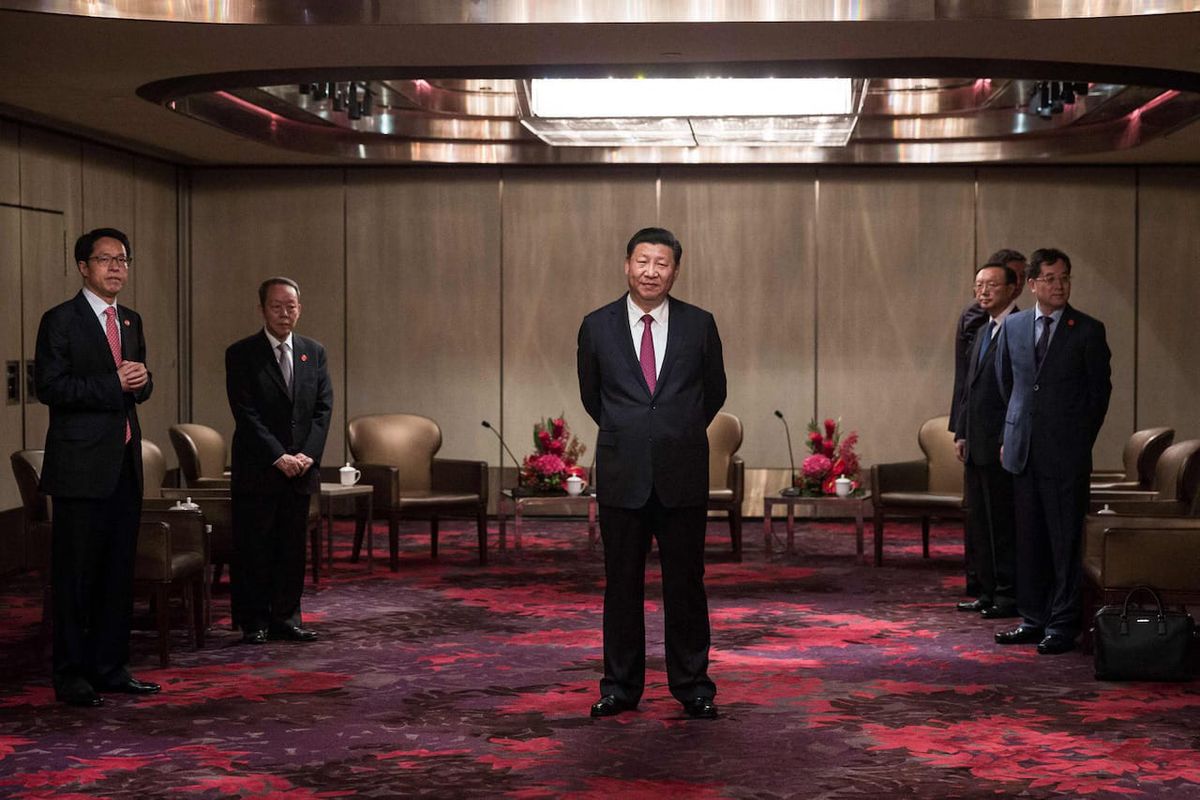
Look at the picture at the top.
One man. Center of the room. Everyone else arranged around him. No noise. No chaos. No committee. Just the quiet architecture of a country that decided what it wanted, and then went and got it.
That's the cat.
It doesn't care what color it is.
It just needs someone willing to let it hunt.